2026 — 2-Stroke Summer Holiday
Pasta and Gyros
Departed: 10 July 2026. Returned: 10 September 2026. Distance: 10,750 km. Countries: 16. Breakdowns: 12. Regrets: none.
Some tours you plan for months. You have spreadsheets. You have a laminated route card. You have a contingency plan for your contingency plan.
This was not one of those tours.
The rough plan was approximately 8,000 kilometres across 9 countries. What actually happened was 10,750 kilometres across 16 countries, a birthday under Meteora, a border crossing into a country that most maps pretend does not exist, and twelve breakdowns that I choose to call character-building experiences.
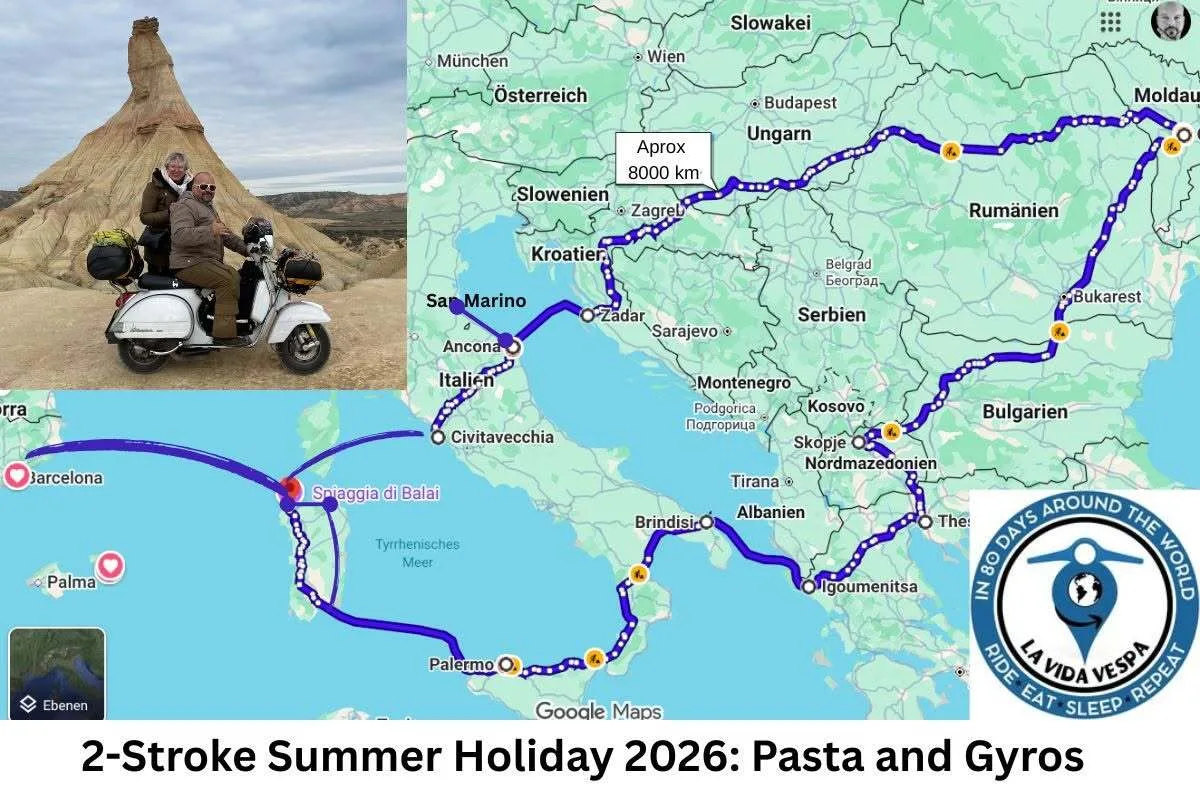
The Route
Spain → Italy → San Marino → Greece → North Macedonia → Bulgaria → Serbia → Kosovo → Romania → Moldova → Transnistria → Hungary → Croatia → Slovenia → Austria → Germany → Spain
Sixteen countries. One Vespa. Zero support vehicle.
Sardinia and Sicily — The Warm-Up
First stop after Barcelona: a ferry to Sardinia, then south to Sicily. In Palermo, Martina joined the tour. We rode together through southern Italy, up toward Brindisi — pasta, heat, the kind of roads that make you forget you are in a hurry. Approximately 2,000 km together, Palermo to Thessaloniki. When she flew home I continued east. Alone, which is when things tend to get interesting.
San Marino — A Small Country That Counts
High on the list of things nobody expects on a Balkans tour: a detour through San Marino. It counts. It is sovereign. It is on the list. That is all that needs to be said.
Greece — Pindos, A Book in Greek and a Birthday Under Meteora
The Pindos Vespa Ride in the mountains of northwestern Greece was everything I hoped it would be. Standing in front of a crowd of Greek Vespa riders presenting my book in Greek was one of those moments where you think: this is an absurd and wonderful way to spend your time on earth.
Then came the birthday. I turned 50 under the rocks of Meteora — one of the most extraordinary places on the planet, where Orthodox monasteries sit on top of stone pillars that rise vertically from the plain below. My friends Dejan from Belgrade and Vangelis and Giannis from Greece were there. Martina was there. It was the right place and the right people.
The Balkans — Capitals and Back Roads
From Greece I rode north through North Macedonia and Kosovo and into Bulgaria and Serbia. The Balkan capitals are full of energy, history and coffee strong enough to fix a Vespa engine. The back roads between them are something else entirely — empty, cracked, occasionally unmapped and frequently magnificent.
Romania — Transfăgărășan and Transalpina
Two of the greatest mountain roads in Europe. The Transfăgărășan crosses the Carpathians at 2,042 metres. The Transalpina reaches 2,145 metres. Both in the same week. Top Gear called the Transfăgărășan the best road in the world. I can confirm it is at least in the top twelve.
Moldova and Transnistria — The Eastern End
Chișinău, Moldova. One of the least visited capitals in Europe. And then, east of the river Dniester: Transnistria.
Transnistria is a breakaway state that declared independence from Moldova in 1990 and has not been recognised by any United Nations member state. It is controlled by Russian and Moldovan forces. The border crossing was the strictest of the entire tour — guards, documents, questions, long pauses while someone checked something in another room. On the other side: Soviet-era architecture, Russian signage, a currency that does not exist outside the territory, and one of the most surreal afternoons of my riding life.
This was the easternmost point of the tour.
The Return — Hungary, Croatia, Slovenia, Austria, Germany
From Moldova I rode west through Hungary and the former Yugoslav republics, through Slovenia, Austria and Germany, and back to Barcelona. The Alps were there. I did not skip them.
The Machine
Valentina — my 1967 Vespa GS150 with a PX 200 engine — carried me 10,750 kilometres across 16 countries and survived 12 separate mechanical incidents. She is still here. So am I. We have an understanding.
Twelve breakdowns across 62 days works out to one every five days. On a 60-year-old scooter in the Balkans in summer, that is practically a factory warranty result.
This Was Not a Micro Adventure
10,750 km. 16 countries. 62 days. One 50th birthday. One border crossing into a country that does not officially exist. Twelve breakdowns. One book presented in Greek. Two friends who came to Meteora. One girlfriend who rode 2,000 km of it with me.
Not bad for a summer holiday.
Frequently Asked Questions
How many kilometres was the 2026 Balkans Vespa tour? 10,750 km across 16 countries between 10 July and 10 September 2026 — significantly more than the planned 8,000 km across 9 countries.
Which countries did the 2026 Balkans tour cover? Spain, Italy, San Marino, Greece, North Macedonia, Bulgaria, Serbia, Kosovo, Romania, Moldova, Transnistria, Hungary, Croatia, Slovenia, Austria and Germany.
What is Transnistria and why is it on the route? Transnistria is a breakaway state east of the Dniester river in Moldova, not recognised by any UN member state and controlled by Russian and Moldovan forces. It was the easternmost point of the 2026 tour and one of the most memorable border crossings of the entire journey.
Where was the 50th birthday celebrated? Under the rocks of Meteora in central Greece — one of the most extraordinary landscapes on earth, where Orthodox monasteries sit on vertical stone pillars. Friends from Belgrade and Greece were there, along with Martina.
What Vespa was used for the Balkans tour? Valentina — a 1967 Vespa GS150 with a PX 200 engine. She survived 12 breakdowns across 10,750 km. Both of us made it home.