80 Days Around the World on a Vespa
1 Pamplona (before start) · 2 Madrid (Sol) · 3 Pedraza · 4 Teruel · 5 Sant Joan de Moró · 6 Barcelona · 7 Tossa de Mar · 8 Mallemort · 9 Genua · 10 Salsomaggiore Terme · 11 Zagreb · 12 Belgrade · 13 Bar · 14 Durrës · 15 Athens · 16 Larisa · 17 Thessaloniki · 18 Istanbul · 19 Safranbolu · 20 Samsun · 21 Ordu · 22 Trabzon · 23 Batumi · 24 Tbilisi · 25 Baku · 26 Aktau · 27 Atyrau · 28 Orenburg · 29 Kizilskoye · 30 Chelyabinsk · 31 Ishim · 32 Omsk · 33 Novosibirsk · 34 Achinsk · 35 Kansk · 36 Nizhneudinsk · 37 Usolye-Sibirskoye · 38 Babushkin · 39 Khorinsky · 40 Sosnovo-Ozerskoye · 41 Amazarskoye · 42 Vladivostok · 43 Donghae · 44 Incheon (flight) · 45 Honolulu (flight) · 46 San Diego · 47 Los Angeles · 48 Atascadero · 49 Santa Cruz · 50 San Francisco · 51 Sacramento · 52 Eureka · 53 Spanish Fork · 54 Kremmling · 55 Byers · 56 Smith Center · 57 Chillicothe · 58 Rockville · 59 Cincinnati · 60 Charleston · 61 West Lynchburg · 62 Virginia Beach · 63 New York (flight) · 64 Amsterdam · 65 Utrecht · 66 Hasselt · 67 Moret-Loing-et-Orvanne · 68 Angoulême · 69 Pamplona · 70 Valladolid · 71 Madrid
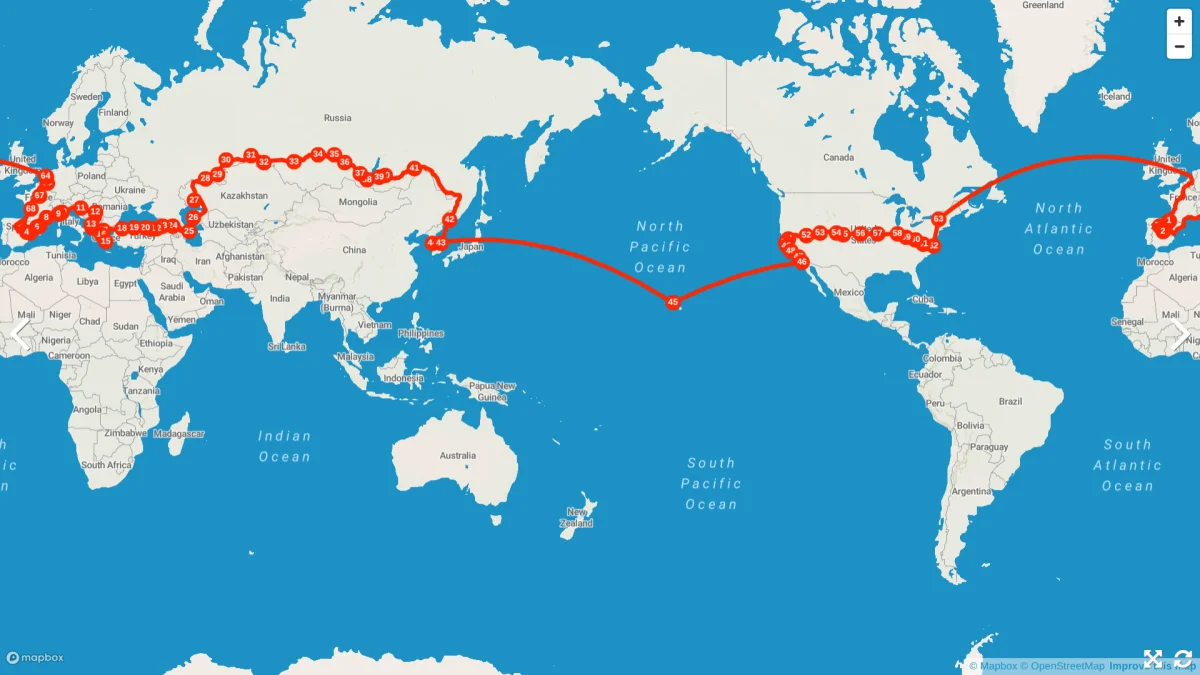
27,113 km · 18 countries · 3 continents · 77+3 days · 30 June – 17 September 2018
There's a quote I gave in my first interview after getting back. Someone asked what I'd say to anyone thinking about attempting the same thing. My answer: "I would never send anyone I remotely like on this trip."
That's not false modesty. That's the most honest sentence I've ever said about anything.
In the summer of 2018 I rode a full circle around the planet — eastbound, Madrid to Madrid — on three classic two-stroke scooters with between 125 and 177cc and somewhere between 7 and 14 horsepower. 80 days. 27,113 kilometres. 18 countries. 3 continents. No support vehicle. No camera crew. No safety net. No common sense, some would argue.
The machines weren't modern bikes with GPS and traction control. They were old, geared, two-stroke Vespas — the kind that requires you to actually understand the mechanics, because nobody in Georgia, Azerbaijan, Kazakhstan or Russia is going to know what a CDI unit is, let alone have a spare one. That's why I carried spare parts for the entire journey: clutch plates, CDI units, spark plugs, connectors, tools, oil and tyres courtesy of Motul and Heidenau. The luggage weighed between 40 and 50 kilograms. The machine weighed considerably less. The physics of this arrangement became interesting on mountain roads. By "interesting" I mean "terrifying."
My Route
- Start: Madrid, Kilometro 0 — June 30, 2018
- Leg 1: Madrid → Vladivostok — 18,800 km
- Leg 2: San Diego → New York — 6,150 km
- Leg 3: Utrecht → Valladolid → Madrid — approx. 2,200 km
- Finish: Madrid — September 17, 2018
I arrived back in Spain by day 76 but chose to spend three days enjoying local wine and food before crossing the finish line at Madrid's Kilometro 0 on exactly day 80 — mirroring the journey of Jules Verne's Phileas Fogg. Some decisions make themselves.
The Numbers
- 27,113 km ridden
- 77 days riding + 3 days of wine and good food
- 18 countries
- 3 continents
- 3 Vespas — one per continent
- 57 technical issues
- ~1,100 litres of fuel
- 12 tyres
- 1 dislocated collarbone
- 5 major storms survived
The Full Picture
The 27,113 km is the world circumnavigation itself — the 80 riding days from Madrid to Madrid, eastbound. That is the number that counts for the record.
But the full project, including preparation, was considerably larger.
Total distance travelled including all transport — flights, ferries, bus, train, scooter — was approximately 74,220 km. Of that, 37,533 km were on the scooter: 27,113 km during the circumnavigation itself, plus 10,000 km riding the US Coast2Coast in 2017 as preparation, plus the Pamplona to Madrid transfer at the start.
The breakdown of how those kilometres were covered:
Riding the US east to west coast in preparation: 10,000 km. Transporting a second scooter by truck to Utrecht: 1,500 km. Transporting a third scooter by truck to Pamplona: 1,500 km. Madrid to Vladivostok through 14 countries: 18,800 km. Caspian Sea and Sea of Japan ferries: 1,300 km. Flight South Korea via Hawaii to the USA: 9,000 km. Second US leg, San Diego to New York: 6,150 km. Flight Norfolk via New York to Amsterdam: 6,500 km. Train Amsterdam to Utrecht: 50 km. Utrecht to Madrid: 2,200 km. Flights to the USA and back for preparation: 16,100 km. Greyhound bus New York to Virginia Beach: 700 km.
Total project duration: approximately 160 days — 80 days riding, 80 days preparation.
Total cost: approximately €25,000 — about €156 per project day.
One more thing worth mentioning: at some point during the journey I had a panic attack. My body was moving constantly, fast, around the planet — and my mind could barely keep up. That was not something I had anticipated. The body is easier to push than the mind.
Why This Is Not a BMW Tour
Some people still compare a trip on a 1970s Vespa to a journey on a modern touring motorcycle. For those people, here are the dimensions.
10-inch wheels. Drum brakes. Four-speed hand gearchange. Almost no suspension travel. 120 kg dry weight. 150cc. 7 horsepower.
What this means in practice: everything the machine cannot do, the rider must compensate for physically.
More hours in the saddle to cover the same distance. More physical strength required. More endurance. More off-road riding skill, because at 10 inches and with minimal suspension, every bad road surface is a direct conversation between the road and your spine. Shorter reaction times required because the brakes and damping are what they are. Less space for luggage. More mechanical wear. Lower visibility to other traffic.
It is strange that this needs explaining. And yet too many people still compare a Vespa world circumnavigation to a weekend trip to Lake Garda on a BMW.
They are not the same thing. Not even close.
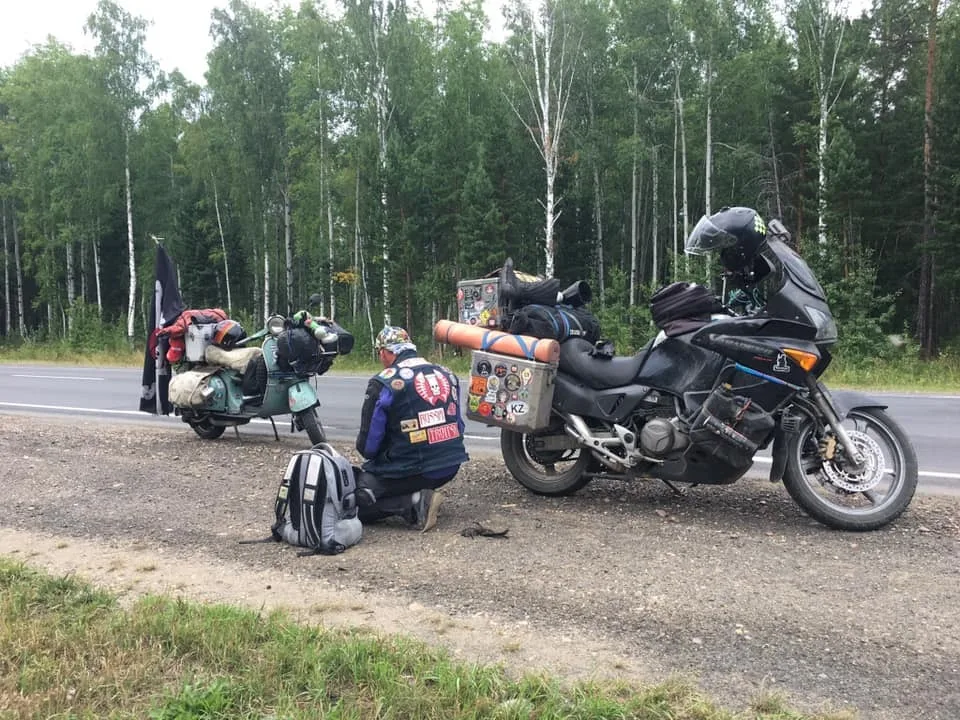
The Paper Trail
When I left Madrid on 30 June 2018, I knew one thing clearly: I had to document everything. Every detail, every number, every name. Partly because I did not want to forget a single moment of the biggest adventure of my life. And partly because I had a feeling that one day I might write about it.
What I did not anticipate was how important that documentation would become for a different reason entirely.
I kept every credit card receipt. Every flight ticket. Every insurance document. Every visa paper. Every border stamp. Because years later, people occasionally doubt the trip happened at all. They look at the numbers — 27,113 km, 80 days, three continents, three classic Vespas — and they decide, based on their own sense of what is possible, that it must be fake.
It is a strange thing, to have to prove that your life happened. But the documents exist, and they are complete, and they say what they say.
More usefully, they mean that when I finally write the book, every fact will be correct. Not approximately correct. Not reconstructed from memory. Correct. Unlike others before me who preferred to make up fairy tales, I have the receipts.
Literally.
Day 52 — A Bus Stop in Siberia
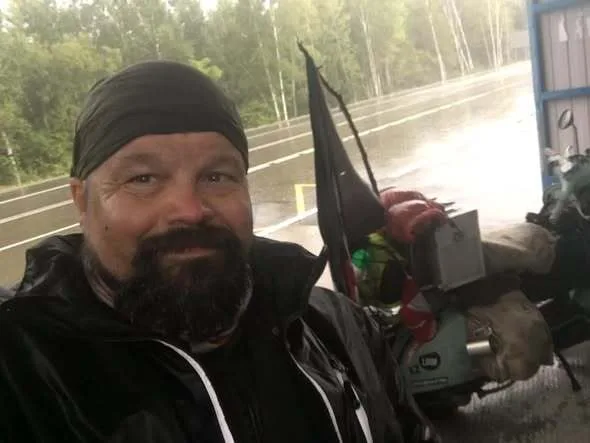
There is a photo of me taken five minutes before one of the worst moments of the trip. I am in a bus stop somewhere in Siberia, rain hammering down outside, the Vespa visible behind me with the pirate flag hanging wet and defeated. I am smiling. I look like someone who has things under control.
Five minutes after that photo, I was standing naked in that bus stop, freezing, with stomach cramps, standing over a pool of blood. Alone.
Here is how it happened.
Ten days earlier, a tyre blowout on a badly deteriorated road had put me in a ditch. An old collarbone injury from my military years came back. I had been riding on maximum-dose ibuprofen ever since, just to keep moving.
Two days earlier, at a petrol station, a friendly Asian mother had shown me a video of a bear that had approached her car to within twenty metres — and mentioned, almost as an afterthought, that a typhoon was heading directly for Vladivostok. My next stop. I had been riding into wind and heavy rain ever since, racing the typhoon.
One day earlier, my rain trousers had torn. Duct tape had not held. I rode soaked because there was no shop that could sell me a replacement.
That same morning, something at breakfast had not agreed with me. I had spent the whole day riding with stomach cramps on top of the shoulder pain.
The rain in the bus stop was so heavy that cars were stopping — their wipers could not keep up. I stopped too. Standing there wet, cold, one injured shoulder, stomach cramps, somewhere in Siberia, I got sudden violent cramps and everything my body had been storing up came out at once. I ride in a full overall with a vest and rain gear. I had thirty seconds to get all of it off. I did not quite manage.
I looked at the floor of the bus stop. Blood. Either my stomach, from fifty-two days of heavy painkillers, or a haemorrhoid from sixteen hours per day in the saddle. I did not investigate further.
People asked me afterwards: did you not want to give up at that moment?
When you have given up your flat, quit your job, left your girlfriend, spent three years preparing and €25,000 saving, and approximately 260,000 people are watching live — you do not think about giving up. There is only one direction. Forward.
I got dressed again. Soaking wet, cold, one functioning shoulder, stomach emptied. I rode toward the typhoon. Toward Vladivostok. Toward the end of the continent and a ferry to South Korea that runs once every seven days, with a visa that would expire one day after the next sailing.
I made the ferry. By now I can smile about the bus stop.
It was worth everything.
What the Numbers Don't Tell You
After twelve days and more than 6,600 kilometres, it starts to hurt. Not the kind of hurt that fades after a rest day — the kind that accumulates compound interest. By three weeks in, meeting your daily minimum of 350 to 600 kilometres is genuinely painful in a way that normal tiredness doesn't prepare you for. Your body absorbs vibration, wind resistance and road shock for up to sixteen hours a day, every single day. There is no ergonomic seat. There is no cruise control. There is you, an old machine, and the road.
Around day forty, something shifts. The pain doesn't disappear — it becomes background noise. After sixteen hours in the saddle, your body is still vibrating when you finally stop and lie down. You fall asleep mid-vibration. In the morning, getting out of the tent takes one to two hours. Not because you're lazy. Because your body has started staging protests you no longer have the energy to argue with. Your spine files a formal complaint. Your backside has stopped speaking to you entirely.
On some nights in Siberia I didn't bother with the tent at all. I rolled myself onto a petrol station forecourt next to the scooter. The calculus was simple: pitch a tent in the dark and risk a drunk man appearing out of nowhere with a weapon, or stay visible on the forecourt. I chose the forecourt.
At day sixty I woke up in a motel room in the middle of a storm, drenched in sweat, from a nightmare I couldn't identify, and walked out into the rain because I genuinely didn't know what country I was in. I stood there until something clicked back into place. Then I went inside and waited for morning. The motel didn't offer a late checkout. Some things transcend language barriers.
By day seventy you're not riding toward anything anymore. You're riding because stopping means failing, and failing is worse than everything else combined. That's when the fourth major storm arrived. The universe has a sense of timing.
Back on European soil, the last 2,200 kilometres felt like a different planet. No more three to five moments of genuine danger per day. Proper roads. Rückenwind — tailwind — in every sense of the word. I nearly cried somewhere near Pamplona. I'm blaming the wind.
I could have finished on day 76. I had the kilometres. But Jules Verne's Phileas Fogg spent his final days eating well and drinking wine in Spain — so I did the same. Three days. Wine, food, stillness. It was a medical necessity.
When I crossed the finish line in Madrid on 17 September 2018, I had completed the fastest solo Vespa circumnavigation in history — on classic Vespas and Vespa licences. The only German-speaking rider to circle the planet on a Vespa. First place in a competition nobody else had entered, which is honestly the best kind.
Was it worth it? Yes. Completely and without reservation.
But I want to be honest about what it cost beyond money, because adventure travel gets romanticised in ways that don't serve anyone planning something similar. This went well beyond my personal limits — physically, mentally, psychologically. If you want to ride around the world in 80 days on a classic Vespa, you will ride every day and every hour the machine works. You will ride into nights. You will ride in rain, in heat up to 46°C, in cold down to 5°C. You will ride through a thunderstorm in mountain darkness, a typhoon, two hurricanes and a tornado. You will probably ride ill. You may ride injured. You will ride when your whole body hurts from 600 kilometres the day before and your lights have stopped working and you still have to make that average or you fall behind and never catch up.
I'm not saying this to earn a pat on the back. I'm saying it because you deserve a realistic picture of what 80 days around the world actually means.
It's not a long holiday. It's something else entirely. My chiropractor agrees.
My Three Vespas
Before I get to the storms and the breakdowns — a word about the machines. Because without understanding what I was riding, nothing else makes sense.
To keep air freight costs and logistical delays under control, I placed three classic scooters strategically across the globe before the start. Each one had a name. Each one had a personality. Each one broke down repeatedly and was forgiven.
Rosinante — Bajaj Chetak 150cc, an Indian licence-built version of the Vespa Sprint Veloce from the 1970s. Rosinante carried me from Madrid all the way to Vladivostok — 18,800 kilometres across Europe and Asia. Named after Don Quixote's horse, which tells you everything about the relationship. Heroic intentions, questionable reliability, unconditional loyalty.
Betsy — LML Star 150 2T, sold in the US as the Genuine Stella — a licence-built Vespa PX 150. Betsy took me from San Diego to New York, 6,150 kilometres across North America. She had been waiting for me in California for a year, patiently rusting in exactly the right places.
The Frankenscooter — a self-built machine assembled from parts of six different Vespas, fitted with a Suzuki fuel tank and a modified old helmet repurposed as the cockpit instrument housing. The Frankenscooter handled the final European leg from Utrecht to Valladolid to Madrid, approximately 2,200 kilometres. It looked like the result of a very optimistic workshop accident. It worked. Mostly.
The Paddle Boat Argument
Ninety-nine percent of people planning a world trip would take the motorcycle on the right. Bigger wheels, more power, better suspension, better brakes, more reliability. Undoubtedly.
Some people think I am arrogant when I say that would be too easy. They think I am bragging.
Consider this: if a triple ironman contestant and a hobby runner who does three miles a day for their health start talking about running, do they have much in common? The ironman is not better than the hobby runner. They are simply operating at different levels of challenge — by choice.
I was looking for a different level of challenge. Something not done by just anyone on their holidays. I did it to prove to myself that I could. The same reason I rode 1,691 km through 10 countries in 24 hours on a 125cc Scomadi in 2015.
Standing afterwards, looking in the mirror and saying "you did it" — that is the most powerful, life-changing, empowering experience there is. No trophy required.
To the people who say: "This is stupid — it is like using a paddle boat to cross the Atlantic."
Hell yes it is like the paddle boat crossing the Atlantic. But you did not understand a thing.
Five Storms
Nature threw everything at me. I survived five major weather events during the journey. I use the word "survived" deliberately.
Day 8 — Thunderstorm, Montenegro Mountains A night ride through unlit tunnels and unpaved mountain serpentines, chased by impatient truck drivers while lightning lit up the peaks around me. No lights worth mentioning. No guardrails worth trusting. Just the road and whatever was on the other side of it.
Siberia — Typhoon Racing toward Vladivostok to catch my ferry to South Korea, I had to outrun a typhoon. The rain was so heavy that cars stopped. Trucks stopped. I took shelter in a bus stop on the side of the highway, watched the water rise around the wheels, and waited for my window. When it came, I took it.
Hawaii & Virginia — 2 Hurricanes I missed both by mere hours — which is either excellent planning or dumb luck, and I know which one it was. The storm in Virginia Beach on Day 71 left flooded roads, uprooted trees and widespread power outages behind it. I called it my wet and wild goodbye kiss from the American continent. America didn't wave back.
Day 65 — Tornado, Smith Center, Kansas The tornado dissolved just a few miles from me — but the resulting storm knocked out my scooter's lights completely. I rode in blind flight for an hour through the Kansas dark until a pickup truck driver pulled alongside, understood the situation without a word being exchanged, and used his roof lights to guide me to a motel. Some acts of kindness are wordless. That was one of them.
57 Technical Issues
Most of the 57 mechanical problems were fixed roadside by me, using whatever tools I was carrying and whatever could be improvised from the surroundings. Military training teaches you to work with what you have. Years of Vespa ownership teaches you that what you have is rarely enough, but you manage anyway.
The damage log reads like a parts catalogue: one cylinder, two clutches, three CDIs, two burst tyres, a complete rear brake failure, two spark plugs, two spark plug connectors, a broken luggage rack and a worn damper. Six days lost in Turkey alone, waiting for parts to arrive. In Baku, the Caspian ferry terminal operates without a timetable — it leaves when it leaves, and arguing with it achieves nothing.
On critical occasions, these people made the difference between finishing and failing:
- Fabio Cofferati — Parma, Italy
- Tamir Hane — Istanbul, Turkey
- ScooterCenter.GR — Thessaloniki, Greece
- Scooterwest — San Diego, USA
I owe each of them more than a line on a webpage. But a line on a webpage is a start.
Sponsors & Support
Approximately 90% of the trip was self-funded — out of personal savings, after I quit my job and gave up my flat to make it happen. Piaggio and Vespa were not involved and I was not a brand ambassador for them. The largest spare parts companies showed little interest. Additional support came from private individuals via PayPal for fuel, food and the occasional birthday beer. You know who you are. Thank you.
Product Partners:
- Motul — Oil for the entire journey
- Heidenau — Tyres and tubes for the complete trip
- Alvivo — Outdoor equipment including sleeping bags and down jackets
- Rare Bird London — Riding gear and facemasks
- Helmade — Custom designed helmet
- One Merino — Merino wool clothing
- SeanSand Bags — Specialised luggage for the scooters
- Deins Designstudio — Design and marketing support
- Second-Ski — Professional supporter
Institutional & Financial Support:
- Vespa Club von Deutschland (VCVD) — Financial assistance
- Vespa Club Hamburg — Financial support
- Vespa Club Hannover — Financial support (home club)
- Auto Kres Zagreb — Oil during the Zagreb stop
- Höfats — Small financial support
Frequently Asked Questions — Vespa World Trip 2018
What is the Vespa world record set by Markus André Mayer? Markus André Mayer completed the fastest solo Vespa circumnavigation in history — on classic Vespas and Vespa licences in 2018 — 27,113 km across 18 countries and 3 continents in 80 days. It remains an unofficial world record as Guinness no longer accepts speed records on public roads.
Was Markus André Mayer alone on the Vespa world trip? Yes — entirely solo. No support vehicle, no camera crew, no second rider accompanied him at any point during the 80-day journey.
Did Piaggio or Vespa sponsor the world trip? No. Piaggio and Vespa were not involved and Markus was not a brand ambassador. The trip was 90% self-funded through personal savings after Markus quit his job and gave up his flat.
How did Markus handle 57 mechanical problems on the road? Most were fixed roadside by Markus himself using military training and years of Vespa experience. Critical help came from Fabio Cofferati in Parma, Tamir Hane in Istanbul, ScooterCenter.GR in Thessaloniki and Scooterwest in San Diego.
Want to read more?