2014 — La Vida Vespa Europe Tour: 22,450 km, 32 Countries, One Old Vespa
Freedom, Grease, and Failing to Buy Milk "Life is too short for lousy jobs and bosses who wouldn't know a joke if it hit them in the radiator."
In early 2014, my life was as exciting as a wet piece of cardboard.
I was 38 years old, rotting away in a stuffy online marketing office in the Allgäu, building websites for tractor manufacturers. My boss wore pink shirts, drove a white Porsche to his skiing holidays, and genuinely believed that asking for weekend overtime was a brilliant way to build "team spirit." I was freshly single. I had the early warning signs of a proper burnout sitting in the back of my neck like a bad passenger. And my life felt like woodchip wallpaper in off-white — functional, but utterly, comprehensively dull.
In me, a voice had been screaming since I was a teenager reading Jules Verne and dreaming of Roald Amundsen — the voice of someone who wanted the horizon, not the pension plan.
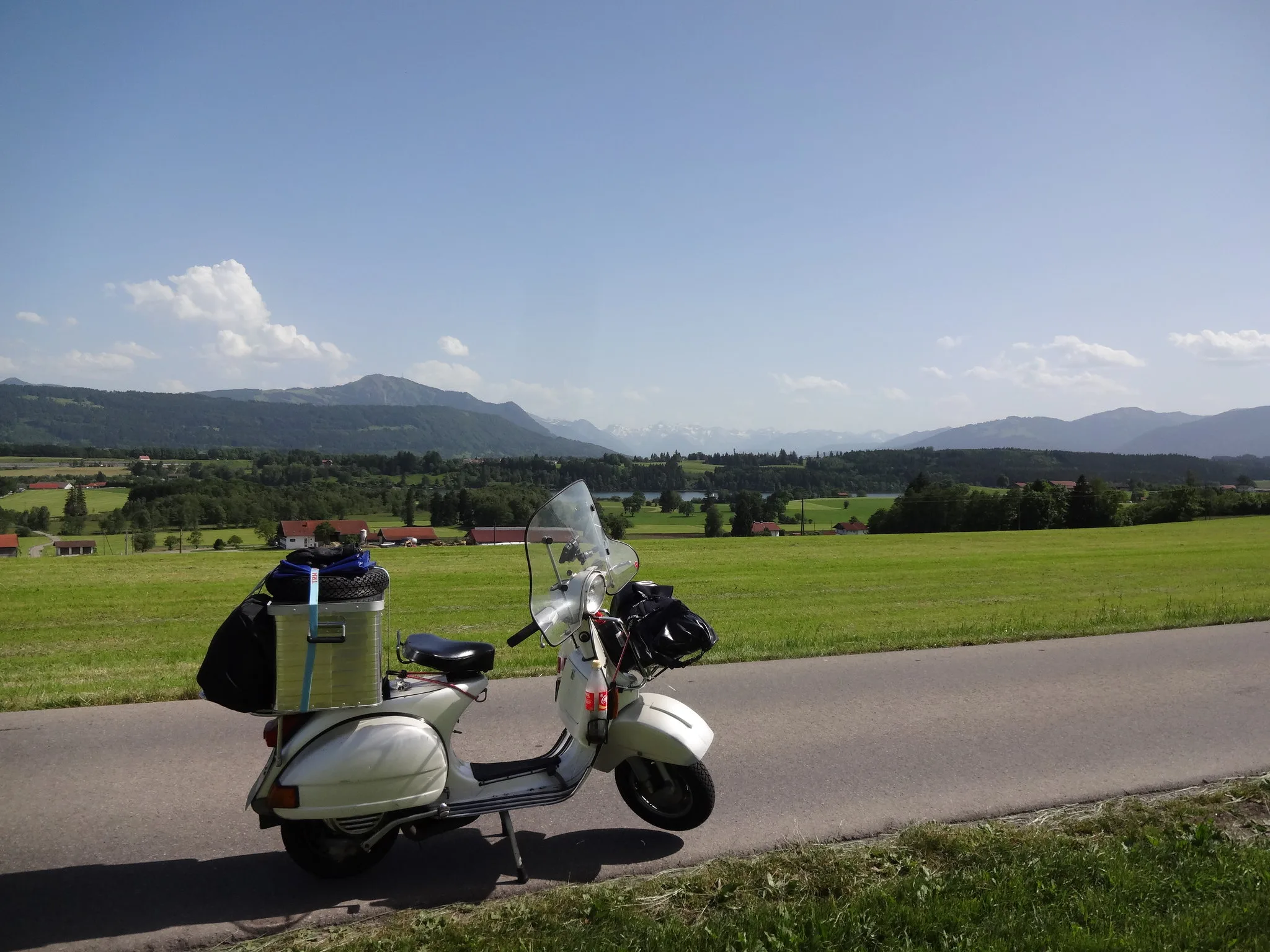
I had enough money in the account to be dangerous. I had a 1979 Vespa P200E in the garage that I'd named Madalina. And I had a plan gathering dust in my drawer since 2011 — visit every European capital on the Vespa. Wildly impractical. Completely unsponsored. Absolutely necessary.
So I quit the job. I gave up the apartment. I sold everything that didn't fit into two bags. I turned the fuel tap to reserve and rode out to see if life still existed beyond the Excel spreadsheet.
What I found was La Vida Vespa. And it changed everything.
The Hard Facts — For the Geeks, Google, and Your Inner Accountant
| Distance | 22,450 km |
| Duration | 130 days — 4 months without a fixed address |
| Countries | 32 — from the Alps to the Atlas Mountains |
| Continents | 2 — Europe & Africa |
| The Machine | 1979 Vespa P200E — Name: Madalina |
| Total cost | ~€6,500 — roughly €50/day |
| Ferry crossings | 14 |
No GPS. No backup plan. No return ticket. Drum brakes that were more of a polite suggestion than an actual stopping mechanism.
Madalina — More Than Just a Shopping Cart
Some people buy an adventure bike for €20,000 — heated grips, traction control, navigation systems that predict the nearest oat milk latte. I had Madalina. An Italian shopping trolley on two wheels, built in 1979, with the aerodynamics of a wardrobe and a suspension that reported every single pebble on the road directly to your spine.
She was 35 years old and had more character than my entire former marketing department combined.
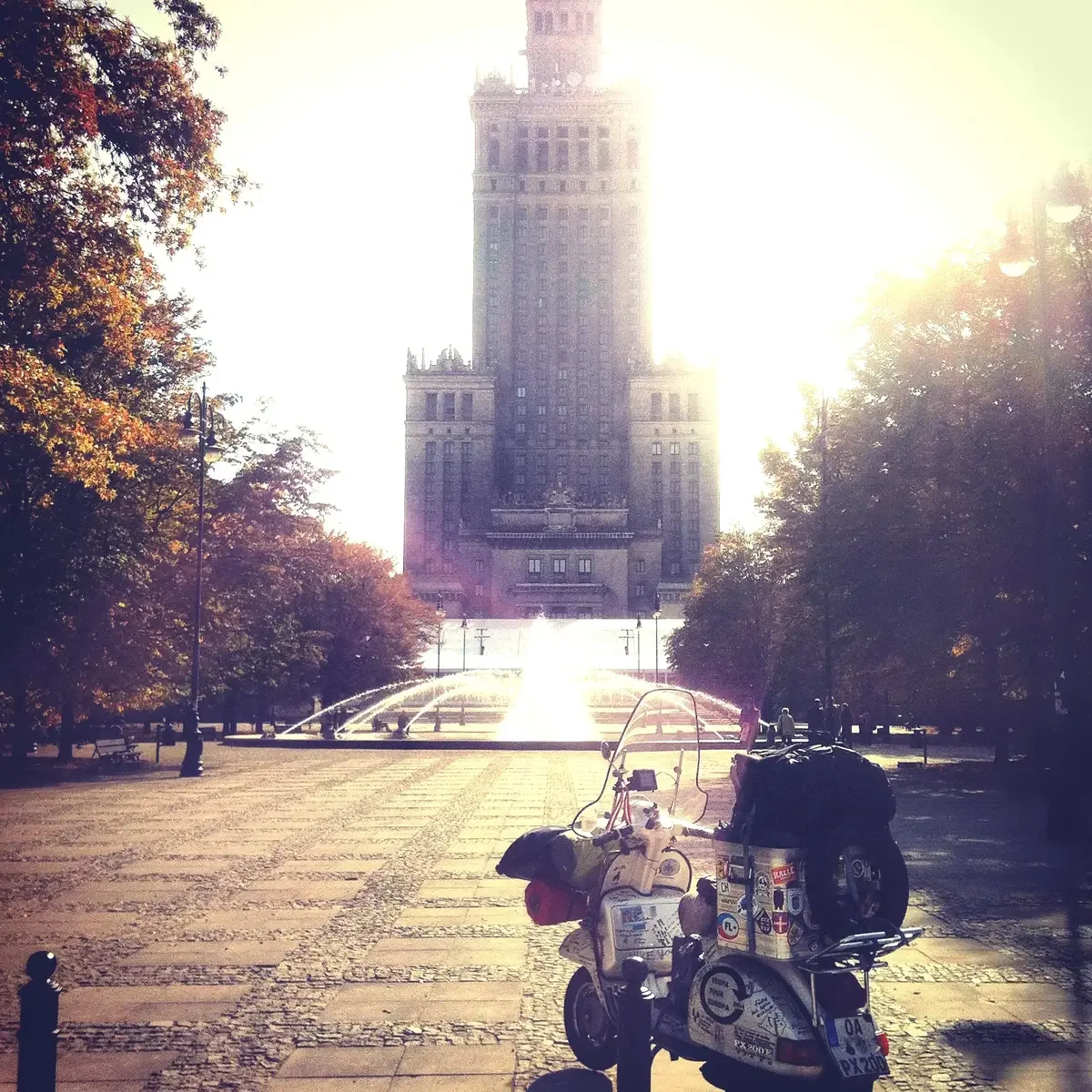
Packed for the trip, she looked like an overloaded market donkey on the way to Marrakech. Every scratch on her paintwork and every signature on her frame told a story — a person who helped, a border crossed, a breakdown survived. She wasn't just a vehicle. She was a bridge. She was the reason strangers invited me to dinner, mechanics stayed late, and Vespa clubs across 32 countries treated me like a long-lost brother.
The golden rule I learned on this trip: if you take care of your Vespa, she will take care of you. Every Vespa I have ridden since has had a name. That started with Madalina.
The Route — From the Alps to the Atlas Mountains
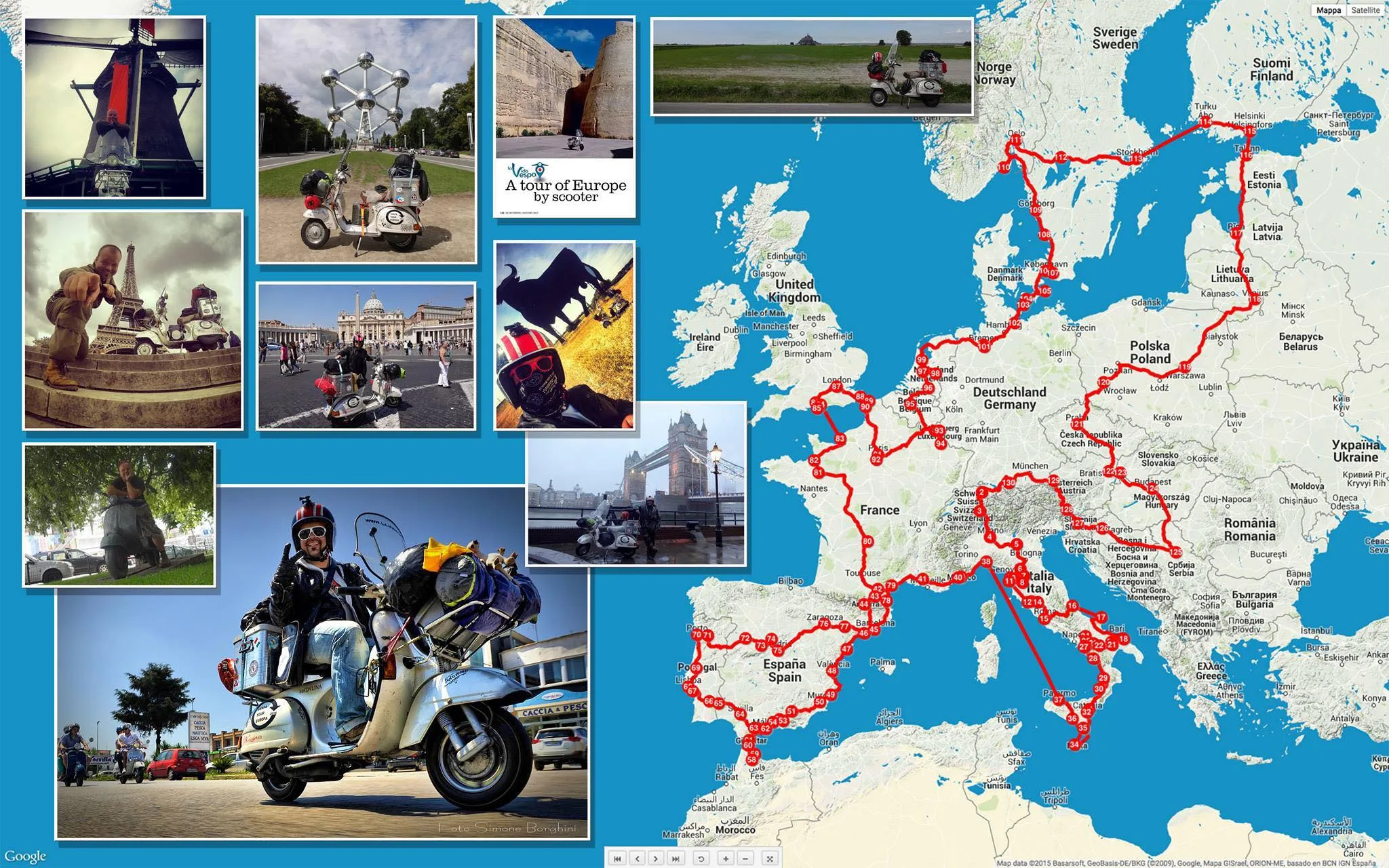
Over the Alps and south
June 2014. Kempten, Germany. I headed south through Liechtenstein and Switzerland, where the mountains made Madalina feel like a very small and slightly confused insect. In Italy everything was "Bella Italia" — right up until it wasn't.
In Liguria, during a massive thunderstorm, I learned that oil, sand and rainwater create a road surface with approximately the friction of wet soap. I slid 30 metres across a roundabout. Bruised ego. Torn rain jacket. Valuable lesson. This is what separates travel from holiday — a holiday involves a pool and Prosecco. Travel involves sitting on a wet roundabout in Liguria at 11pm wondering if your insurance covers "pilot error in a storm."
In Salerno, I decided to wash Madalina — a gesture of affection she did not reciprocate. Water got into the electrics. I spent several days waiting for a mechanic while the rest of Europe continued without me. Lesson learned: old Vespas prefer dust.
Despite all of this: standing in St. Peter's Square in Rome. Looking at the dying clifftop city of Civita di Bagnoregio. Watching the sun go down over the sea from Salerno. Every breakdown was worth it.
The night above the clouds
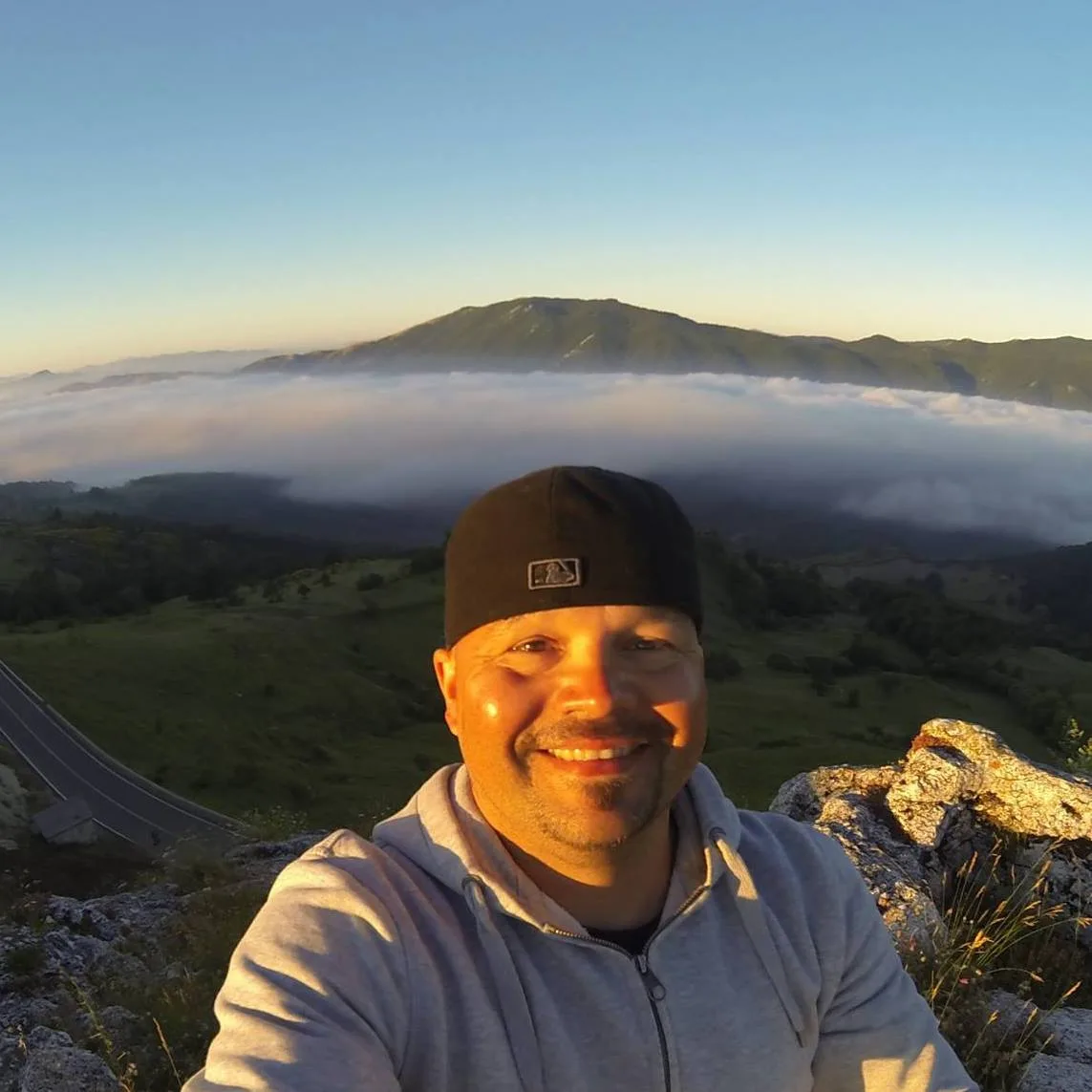
Somewhere in the Italian mountains, the fog rolled in so thick I couldn't see my own front wheel. No hotels. No campsites. Nothing. I rode slowly uphill until I was above the fog line. Then I stopped, unrolled my sleeping bag, and lay down next to Madalina under ten million stars. The silence was absolute. The sky was ridiculous. I remember thinking: no one in that office has any idea this exists.
Morocco — the detour that became the point
In Spain, I saw the signs for Tangier. My heart started beating faster than a two-stroke at full throttle. My head said: stay on the route. My heart said: Africa is right there. I took the ferry.
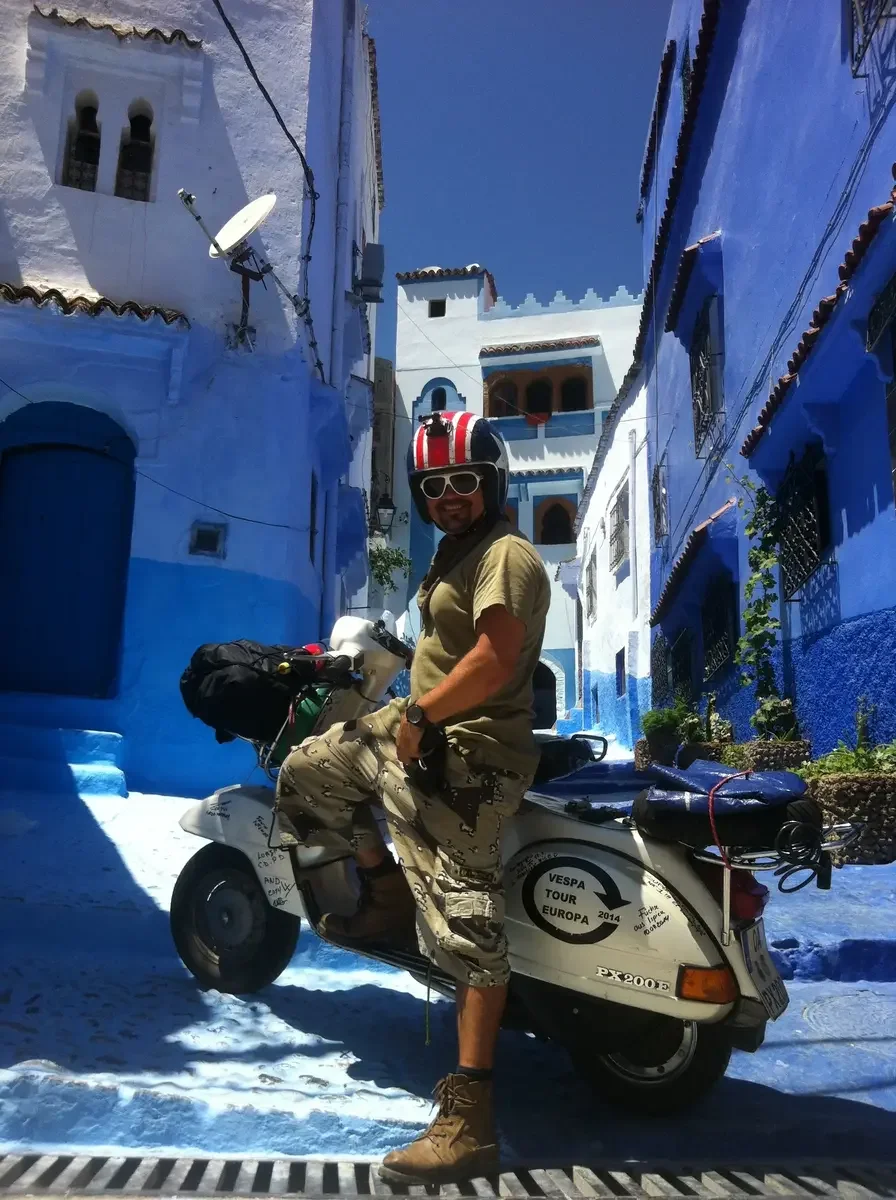
Suddenly I was navigating the blue-washed alleyways of Chefchaouen on 10-inch wheels, deeply confused and completely in love with the world. The smell of spices mixed with the familiar scent of two-stroke exhaust. In the mountains of Morocco I understood something that no motivational poster has ever managed to say properly: the world is a genuinely good place when you approach people with a smile and respect instead of barricading yourself behind your assumptions.
That detour became the defining moment of the trip. That was when I tasted blood.
The Iberian Peninsula
Back through Spain. I slept in the car park of the Alhambra in Granada. I crossed the Sierra Nevada, where a group of Audi test drivers spotted Madalina at altitude and gave me a thumbs-up — probably because they genuinely couldn't believe a 45-year-old Vespa had made it that high. I rode past Gibraltar and continued to Lisbon. The panorama of the Tagus river stays with me to this day.
The Desert Disaster — Los Monegros, Spain
Leaving Madrid, Madalina broke down after 80 km. A Polish truck driver at a motorway stop saved the day with a spare connector — one of those moments where the world's generosity arrives in completely unexpected packaging.
I made it to the Cuatro Acentos Escúter Club in Zaragoza, spent time with their crew, and felt briefly invincible. Then I reached the Los Monegros desert. Somewhere in that vast, scorched nothing, I lost my wallet. Passport. Cards. Cash. Everything. What remained: 1.50€ and a Vespa with a full tank.
I spent the night behind a truck stop, between rubbish and a family of rats, feeling considerably less like Phileas Fogg and considerably more like a man who had failed at basic adulting in spectacular fashion.
The next morning, Oscar and Davit from the Cuatro Acentos Escúter Club rode 50 km into the desert to find me. They bought me lunch. They handed me 100€. They asked for nothing in return.
I made it to France on Western Union transfers from my family, my second passport hidden in the Vespa, and the kind of gratitude that does not fit into words. The real friends, I learned that day, are the ones who come when you call from a desert.
Perpignan — Palmarium Scooter Club Rally
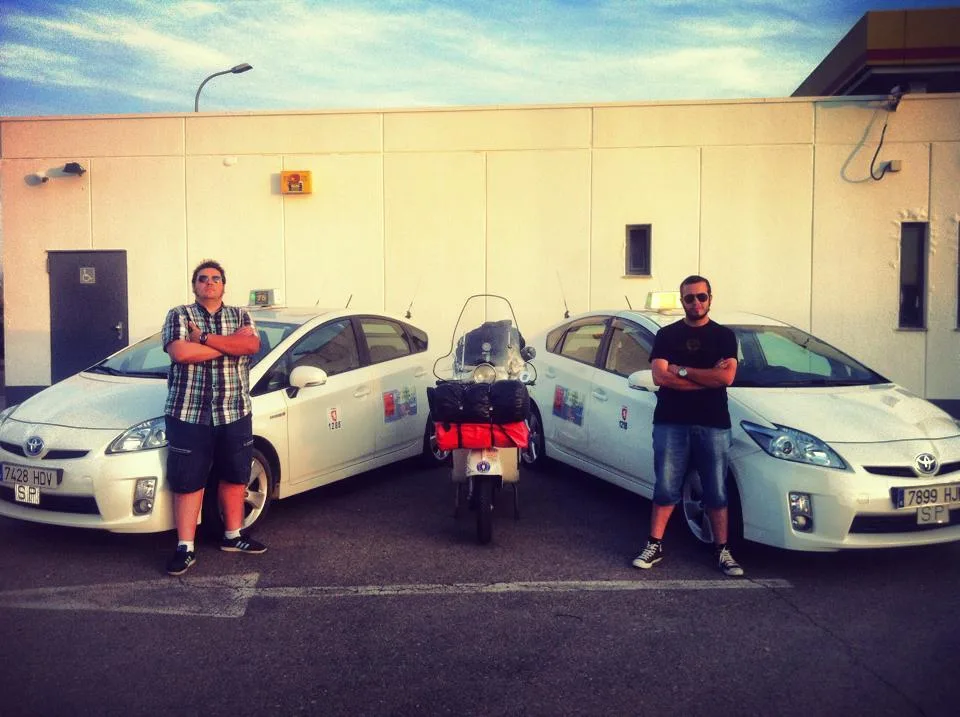
My first stop across the French border was Perpignan, where the Palmarium Scooter Club had organised a rally. I arrived smelling of gear oil and desert dust, looking like a man who had recently lost everything and found it again. They welcomed me without questions. Mediterranean light, cold beer, and the sound of two-stroke engines in a French courtyard — after Los Monegros, it felt like arriving in a different world.
The United Kingdom — rain, rejection, and a uniform
I crossed to the UK by ferry and arrived at the legendary Isle of Wight Scooter Rally. It was there, entirely by accident, that I found my first pilot suit — windproof, pockets for tools and food, and so absurd-looking that it was clearly right for me. It became my trademark for the next decade of travel.
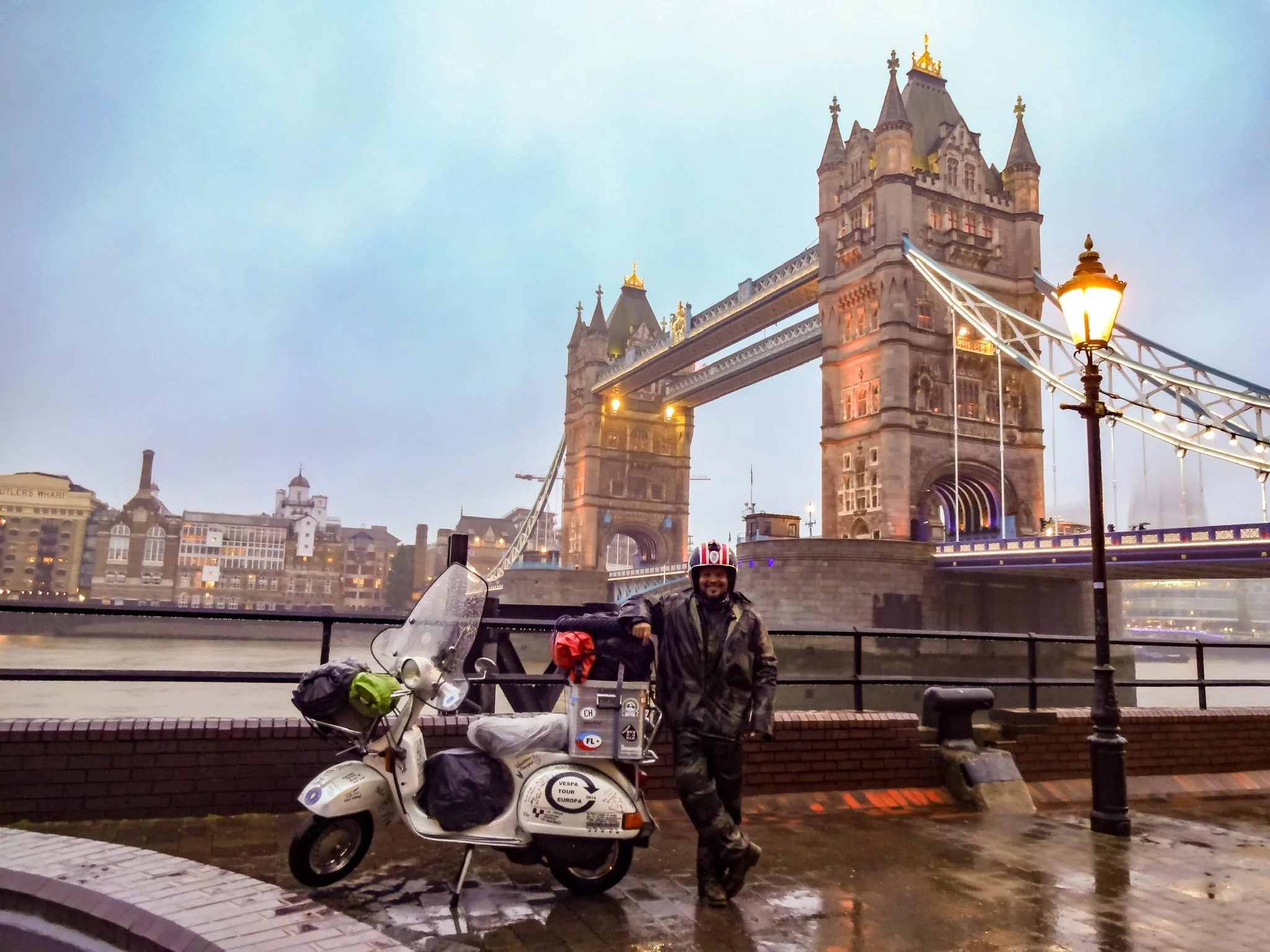
Then London. It rained. Of course it rained. After 12,000 kilometres I was soaked through, covered in road grime, and my boots made sounds like a swamp creature with every step. Two hostels turned me away because I was too wet. One turned me away because, apparently, I was too old. I eventually found a floor to sleep on, which felt like a five-star hotel by that point.
Scandinavia — Copenhagen and the yacht
North through Belgium and Holland into Scandinavia. In Copenhagen I was invited to sleep on a yacht called Good Enough in the harbour. A name that perfectly summarises my entire life philosophy: it doesn't need to be perfect, it just needs to be good enough to keep going. The contrast with the nights spent in forests and bus shelters was not lost on me.
The long way home — Baltics, Poland, Prague
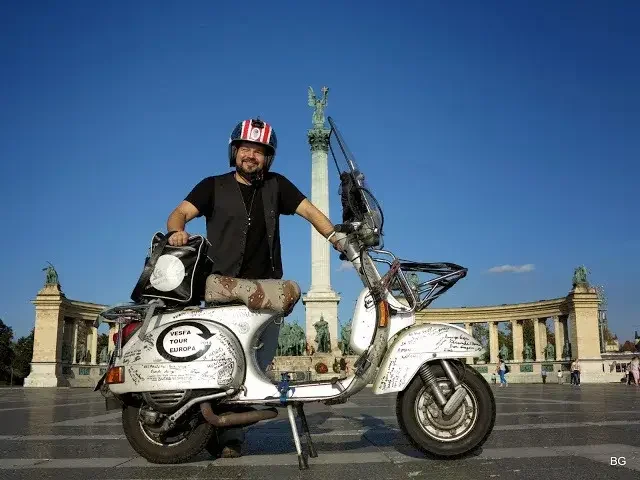
Finland. Estonia. Latvia. Lithuania. Poland. A few kilometres before Prague, Madalina rolled through the 20,000-kilometre mark. I celebrated with a night of sightseeing in the city before heading south through Slovakia, Hungary, and the Balkans back to Germany.
The Arrival — A Different Man Returns
I rolled back into the Allgäu on a Tuesday in October 2014, exactly 130 days after leaving. Two days later, it started to snow.
My bank account was empty. I had spent €6,500 in total — about €50 per day — and had precisely nothing to show for it in any conventional sense. No promotion. No property. No plan.
And I felt richer than any CEO I had ever worked for.
Madalina was covered in the signatures and stickers of hundreds of people who had helped me along the way — mechanics who stayed late, club members who fed me, strangers who pointed me in the right direction at midnight in places I couldn't find on a map.
I had come back as a different man. The 38-year-old who had been slowly dying in a swivel chair was gone. In his place: someone who had learned that "someday" is a terrible plan, that the world is overwhelmingly full of good people, and that a 200cc engine from 1979 is more than enough to cross 32 countries and two continents.
I could not go back to the cubicle. I was out of the matrix. Permanently.
Out of the need to tell my family I was still alive, La Vida Vespa was born. From an escape, a philosophy.
What I Learned — The No-Kitsch Version
People always ask what a trip like this teaches you. They expect a motivational poster. Here is the reality:
Priorities are everything. We all have roughly 4,000 weeks to live. I didn't own a car for ten years so I could have those 130 days. You don't have time or money because you've chosen to spend both on the wrong things.
The machine is never the reason. You don't need 1200cc. You need curiosity and the willingness to suffer occasionally. Madalina had 200cc and carried me through 32 countries. If anyone tells you that you need a €20,000 adventure bike to see the world, they have never sat on a P200E and watched the sun rise over the Atlas Mountains.
Fear is a paper tiger. The most dangerous things happened in my head, not on the road. The roundabout in Liguria was unpleasant. The office was slowly killing me. The road won.
Humanity is generally good. From Audi test drivers in the Sierra Nevada to Greek scooterists who found me lost at midnight, the world is full of people willing to help a madman on a packed Vespa.
Madness is required. If you wait until you are fully prepared, you will never leave the driveway.
Frequently Asked Questions
Why did you start riding long distances on a Vespa? Burnout, bad boss, fresh separation. I quit at 38, gave up the flat, and bought a 1979 Vespa P200E. The 2014 Europe tour was my way back to myself — and the beginning of La Vida Vespa. The short version: my boss was unbearable and Morocco was only 14 kilometres away.
What is Madalina? A 1979 Vespa P200E — my first long-distance travel companion, named and loved like a partner on the road. She carried me through 32 countries and 22,450 km. She is currently retired and refusing to discuss it.
How much did the trip cost? €6,500 total — roughly €50 per day. Basic accommodation, cheap food, and the extraordinary generosity of Vespa clubs across Europe. I came home broke. Worth every cent.
Is a Vespa P200E suitable for long distance travel? Absolutely. The P200E is one of the most mechanically simple and robust Vespas ever built. Spare parts are available across Europe. Basic maintenance is learnable in a weekend. The only thing Madalina objected to was being washed in Salerno — and honestly, fair enough.
Why Morocco? Because Africa was right there. 14 kilometres across the Strait of Gibraltar. Standing in southern Spain, crossing felt like the obvious next step. That is how La Vida Vespa works: you follow the road, not the plan.
Want to read more?
📷 Photo Gallery
more photos