Why a Scooter? Because We Were 16 and Broke.
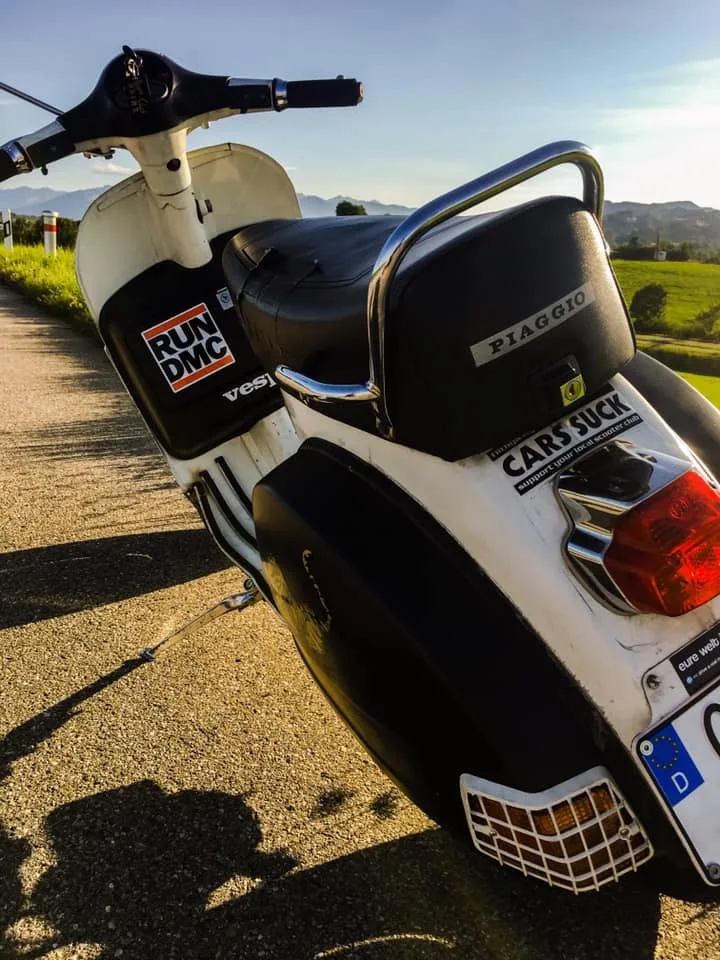
I remember being 16. We lived on the outskirts of a small town. Buses were infrequent and unreliable, and if you wanted a girlfriend you needed a moped or a scooter. Enduros were for farm boys. So it came down to Vespa or Lambretta.
Nobody asked us twice.
The Parts Problem
There was no internet. The companies that are today's market leaders for Vespa parts were still operating out of someone's mother's garage. Finding what you needed meant spending hours in a car with a friend, driving to wherever someone had heard there might be parts, consulting catalogues printed on photocopier paper.
Chrome side panels required days of hand-stripping before you could even start polishing — more days of polishing — before you might find someone willing to chrome them for 300 Deutschmarks of pocket money, if you were lucky and they were in a good mood.
A Union Jack seat cover? You bought a musty flag from an African immigrant's junk shop and then found an apprentice upholsterer willing to stretch it over your seat as a journeyman's project. You fitted a Garelli mudguard because it was lighter and looked good. Tuning meant removing absolutely everything, because you believed every gram counted and you wanted to beat the boy next door by 7.5 km/h.
We had no idea what we were doing. We had an extraordinary amount of fun.
The Engineering
The approach to performance tuning was straightforward: buy a 207cc or 135cc cylinder from a friend of a friend who lived 100 km away, one that had already seized once, and sand the head by hand on sandpaper until you had removed a few millimetres. This ruined the compression, which we did not fully understand at the time.
The consequences revealed themselves at full throttle on the autobahn, in the rain, at night, on the way to a mud rally in a gravel pit. Seized piston. We cut a hole in the autobahn fence, hid the scooter in a bush, redistributed ourselves across the remaining machines, and returned hours later in an old VW van with 50 horsepower to collect it. The fuel leaked into the seat on the way home. The seat swelled up. We had long since stopped being surprised by developments like this.
We built switches into the glove compartments to kill the rear light and number plate, for escaping the police across field paths — because of the illegal tuning, or the two grams of something that someone almost certainly had on them. We met under motorway bridges because eventually nobody wanted a group of teenage chaos agents in front of their house. We took turns doing wheelies and Vespa cross in swimming shorts and destroyed the chrome panels in the process. We raced each other on the street in front of the house daily, annoying the neighbours with the noise and the speed. The road was a circuit. Everything was a circuit.
Fuel mixture was measured either at the special pump or by eye. Mostly by eye.
Were We Fast?
Only in terms of how it felt.
Were we hooligans? Yes, without question. Did we respect authority, weather, or the laws of physics? We did not. Did we occasionally lose a wheel at speed because the scooter had been assembled on Sunday night for Monday's school run and a few bolts remained unaccounted for? Also yes.
What We Actually Had
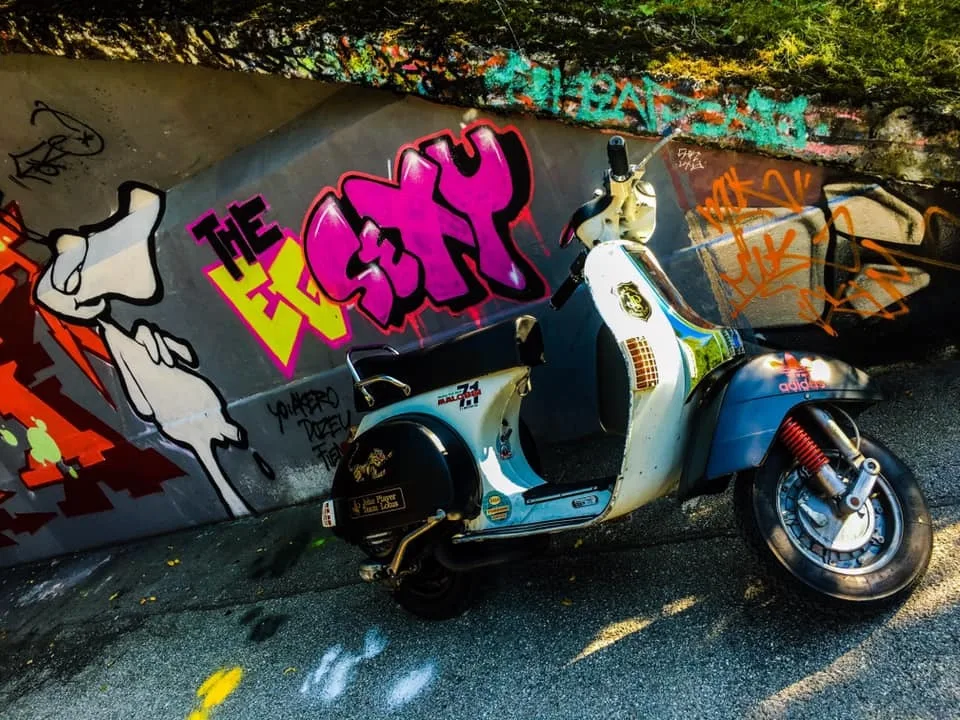
We had some tools, an idea, a spray can, a few stickers, and complete conviction that this was sufficient to build something worth riding. We wanted to ride every day, regardless of weather, on whatever we had earned from washing cars, delivering newspapers, and mowing lawns. We wanted to lean into corners until the footpegs threw sparks into the night.
We slept in supermarket tents with canned beer and pretzels at campfires. Occasionally in the lobby of a Sparkasse bank. We wore hoodies, not polo shirts. Run DMC and Beastie Boys, not whatever the current acceptable soundtrack of the scooter lifestyle has become.
What I See Now
Today I sometimes watch people arrive at events with their scooters on trailers. Thirty-horsepower Faro Basso builds assembled by professional mechanics. Amazon-ordered retro outfits. Prosecco in the sun. Awards given to each other for attending. Hotel rooms booked in advance.
I do not want to be uncharitable. They are having a good time. Good for them.
But I miss the era when the entry requirement was passion, a second-hand machine, and the willingness to lie on the tarmac in the rain fixing something that probably should not have broken if you had assembled it correctly the first time. When a custom scooter was built by hand with whatever was available, and ridden hard and illegally and magnificently.
The memories from that era have outlasted everything that came with more money and more planning.
A spray can, some stickers, a bad idea, and a full tank. That was the recipe. It still is.